
The SIAOAIR® Reliability Discipline
For decades, reliability engineering focused primarily on machines. Infrastructure became observable. Constraints became measurable. Systems learned how to operate within defined operational limits.
But intelligent systems built on Artificial Intelligence have fundamentally changed execution dynamics.
Reliability no longer degrades only within infrastructure. It increasingly degrades at the human–execution boundary — where continuous machine execution converges with finite human judgment under growing execution pressure.
As signal density, autonomous actions, dependencies, and decision velocity scale across systems, human capacity — cognitive, attentional, physiological, and emotional — becomes a critical operational constraint governing whether execution remains stable, coherent, and reliable under load.
At scale, this boundary emerges as one of the system’s most consequential operational leverage points.
Human-Aware Reliability
Reliable systems must govern this boundary — not after failure, but during execution itself.
Where execution demand meets human capacity.
Where decisions stabilize or destabilize the system.
Where balancing feedback either holds or reinforcing instability compounds.
This is the leverage point where operational stability is either preserved or lost.
The SIAOAIR® Model
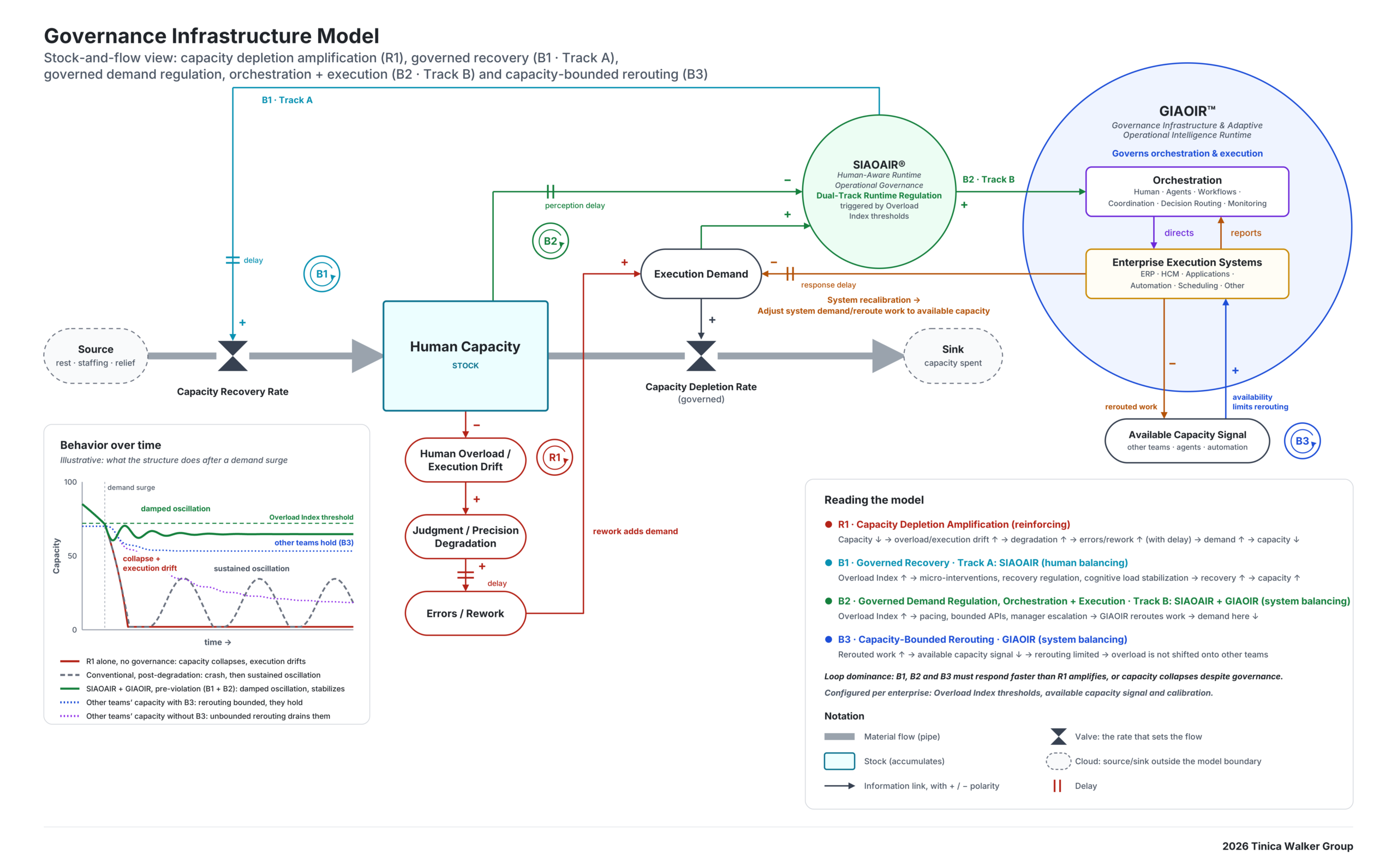
SIAOAIR® introduces the balancing B1 & B2 loops. It senses capacity deficit and translates human-awareness signals into governed execution, allowing the system to regulate demand before overload compounds.
The shift is fundamental: instead of requiring humans to continuously adapt to system demand, the system becomes capable of adapting execution to human capacity.
The model is built on four principles:
Human Constraint Principle
Human capacity is a real operational constraint.
Capacity-state must become observable, measurable, and governable at runtime.
Execution Boundary
The interface between machine execution and human judgment must be intentionally architected.
This boundary becomes the operational leverage point governing execution reliability under scale.
Operational Governance Architecture
Execution must remain observable, governable, bounded, and coherent as intelligent systems scale.
Governance mechanisms regulate execution demand relative to human capacity-state, reducing instability amplification across the system.
Human Reliability Envelope
Systems must operate within the range where human judgment can reliably stabilize decisions.
Execution remains proportional to human capacity-state, preserving operational stability under accelerating demand.
The Foundation
Together, these principles establish a new reliability discipline:
systems do not simply optimize execution.
They regulate execution relative to human constraint.
Not reactive.
Regulatory.
Operational stability becomes governed at the leverage point where machine execution meets human judgment.
Under load.
Under scale.
In real time.
Resilience becomes infrastructural.
That is the SIAOAIR® reliability discipline.
Resilience reacts. Runtime empathy regulates.