
SIAOAIR®: Human-Aware Runtime Operational Governance
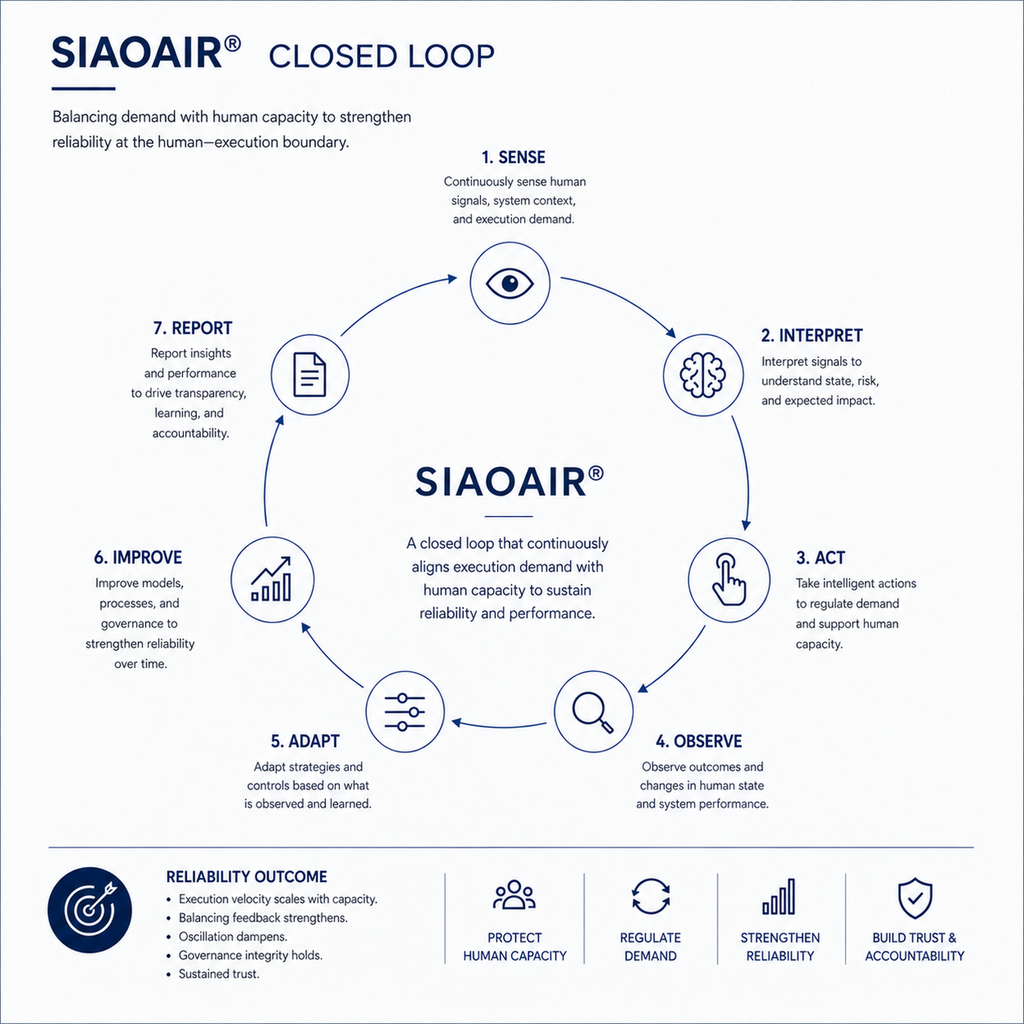
SIAOAIR® is a 10-layer modular platform defining the frontier of Human-Aware Runtime Operational Governance for artificial intelligence at the human–execution boundary.
Deployed on-device across edge hardware, SIAOAIR® makes human capacity visible at runtime by surfacing governed capacity-state signals where artificial intelligence execution converges with human judgment..
Why It Exists
Artificial intelligence is accelerating execution. Signal density is compounding as agents, workflows, alerts, escalations, approvals, scheduling changes, and autonomous actions now operate continuously across systems, increasing the need for stable intelligence grounded in awareness of state, feedback, limits, and adaptation inside the loop itself.
Signal density is the frequency at which a system requires human judgment at the execution boundary.
Infrastructure evolved to govern machine constraints — compute, memory, queue depth, and network pressure — but intelligent systems still lack visibility into one critical constraint: human capacity.
Human capacity is the finite cognitive, emotional, physiological, and attentional state required for safe and reliable decision execution within intelligent systems.
As execution pressure scales, organizations increasingly compensate through human adaptation instead of structural regulation. People absorb more coordination load, context switch faster, suppress recovery, and manually stabilize conditions the system itself cannot see.
This creates reinforcing overload dynamics and “Shifting the Burden” patterns where short-term continuity is sustained through increasing human effort rather than redesigning the conditions generating instability.
Over time, coordination friction compounds, escalation loops intensify, judgment precision degrades, and execution drift propagates across execution boundaries.
Reliability degrades before infrastructure fails.
SIAOAIR® exists to restore proportionality between execution demand and human capacity-state by making human capacity observable, governable, and enforceable at runtime — introducing the balancing conditions required to stabilize intelligent systems before overload patterns compound beyond recovery.
What It Does
SIAOAIR®:
- surfaces human capacity-state as a runtime signal
- exposes governed signals through operational interfaces and APIs
- enables execution systems to regulate demand relative to human capacity-state
SIAOAIR® does not execute work or replace orchestration systems. It enables intelligent systems to remain stable, coherent, and governable as execution velocity scales.
How It Operates
Humans — judgment · capacity · recovery
↑
SIAOAIR® — Human-Aware Runtime Operational Governance embedded on-device at the human–execution boundary
↓
Intelligent Systems — agents · workflows · orchestration · scheduling systems
Execution becomes responsive to the constraint that stabilizes the system: human judgment reliability.
This is empathy embedded at runtime.
The Result
- Execution demand aligns to human capacity-state
- Reactive correction shifts toward proactive regulation
- Balancing feedback strengthens
- Reinforcing overload loops weaken
- Reliability stabilizes under accelerating intelligence
Resilience as Infrastructure
As intelligent systems scale, human capacity becomes a primary system constraint.
Reliable systems must govern this constraint the same way infrastructure governs compute limits.
SIAOAIR® introduces the operational governance architecture that makes this possible.
Empathy is no longer an expectation. It becomes operational infrastructure.
That is the leverage point.