
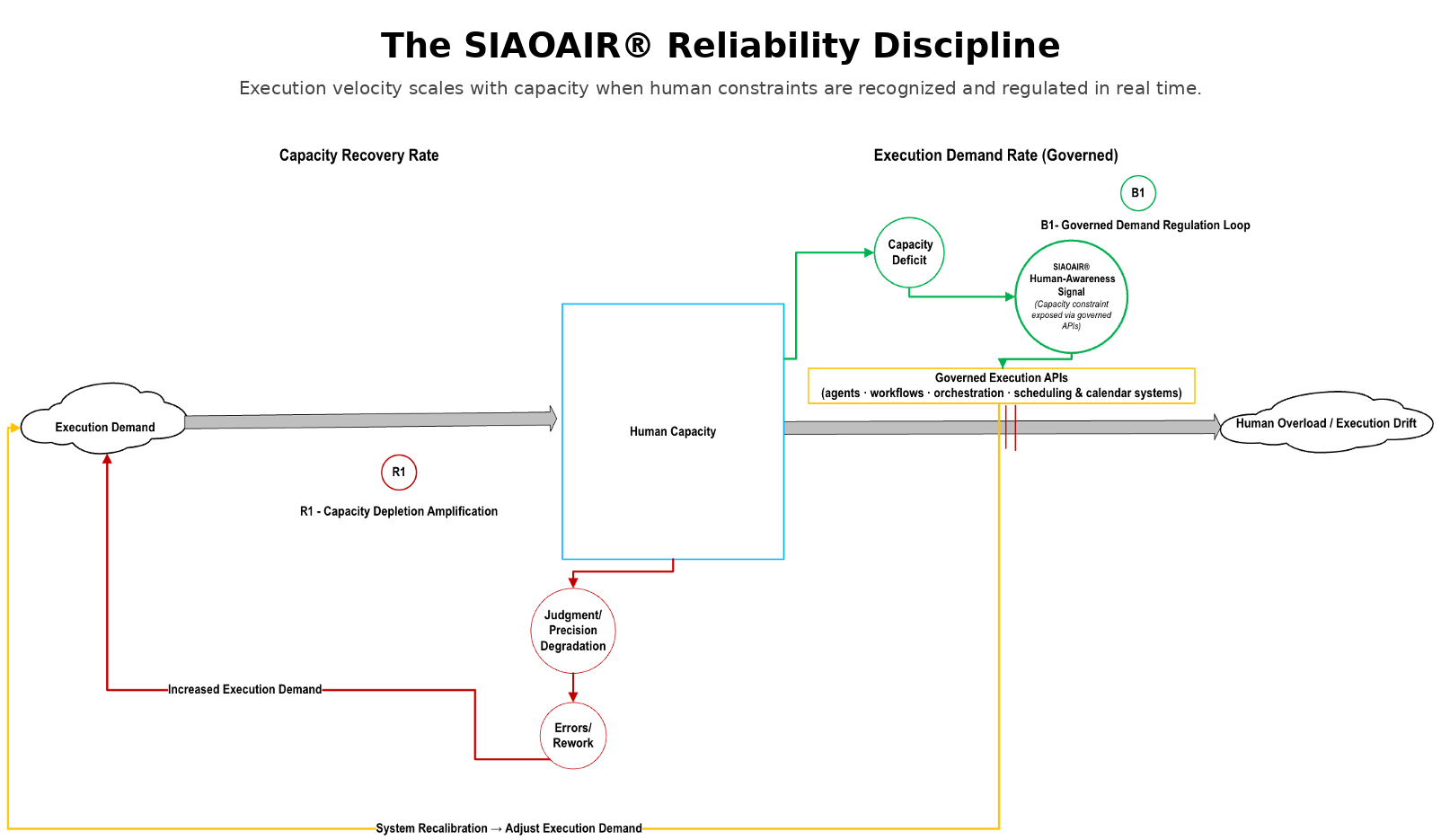
Strategic Planning Assumption: Through 2028, intelligent systems that scale machine execution without making human capacity observable at runtime will see reliability degrade at the human–execution boundary — because execution demand keeps rising while the human capacity required to govern it does not.
Overview
An Interdisciplinary, Heterogeneous Systems Framework
Intelligence accelerates execution. Human capacity determines whether that execution remains reliable.
Modern intelligent environments operate as heterogeneous systems—connecting humans, AI agents, automation, workflows, and computational infrastructure with different operating speeds, capabilities, and constraints.
Yet while machine execution can scale continuously, human judgment operates within finite cognitive, physiological, and attentional capacity.
This creates a structural reliability challenge at the human–execution boundary.
Reliability therefore requires an interdisciplinary approach integrating systems thinking, reliability engineering, human factors, control theory, computational intelligence, and operational governance.
Analysis
1. The four principles of human-aware reliability
The SIAOAIR® Reliability Discipline establishes four interconnected principles:
| Principle | Reliability Function |
|---|---|
| Human Constraint Principle | Recognize human capacity as an observable operational constraint |
| Execution Boundary | Define where machine execution intersects human judgment |
| Operational Governance Architecture | Establish bounded, accountable execution under changing conditions |
| Human Reliability Envelope | Define the operating range within which human judgment remains reliable |
Together, these principles establish the conditions for regulating execution relative to human capacity.
2. Governing heterogeneous systems
Human and computational systems operate under fundamentally different constraints.
Machines scale processing and execution. Humans contribute contextual understanding, experience, judgment, and agency.
As execution demand increases, these differences create reinforcing pressures.
R1 — Capacity Depletion Amplification
Execution Demand ↑ → Human Capacity ↓ → Errors and Rework ↑ → Execution Demand ↑
Without balancing feedback, the system can reinforce the conditions producing instability.
B1 — Governed Demand Regulation
Capacity Deficit Detected → Human-Awareness Signal → Governed Execution Response → Demand Regulation → Capacity Recovery
SIAOAIR® introduces the human-awareness signal that enables authorized execution systems to activate this balancing feedback loop.
3. The interdisciplinary reliability discipline
Reliable execution requires integrating:
- Systems Thinking to identify reinforcing and balancing feedback loops.
- Control Theory to understand system stability, feedback, and regulation.
- Human Factors to model cognitive load, physiological constraints, and judgment reliability.
- Reliability Engineering to identify degradation and failure propagation.
- Computational Intelligence to interpret changing conditions and generate actionable signals.
- Operational Governance to ensure execution adjustments remain permissioned, bounded, reversible, and accountable.
The objective is not to make human and machine systems operate identically.
It is to maintain reliability across their differences.
Recommendations
The architectural imperative
As intelligent systems become increasingly autonomous, reliability cannot depend on humans continuously absorbing expanding execution demand.
The architecture must recognize changing human constraints and enable execution systems to respond within governed boundaries.
SIAOAIR® makes human capacity observable at runtime, providing the signal through which governed systems can regulate execution.
The defining question is no longer how much execution intelligent systems can sustain.
It is whether execution can remain stable as human capacity changes.
Bottom Line
Resilience reacts. Runtime empathy regulates.