Resilience as Infrastructure: Empathy in Artificial Intelligence Systems

The Limitation of Empathy as a Trait As AI scales, empathy is often framed as a human advantage — something to preserve alongside automation. That framing does not hold at system level. Empathy does not scale as a trait. It scales as infrastructure. The Structural Problem AI is increasing decision velocity, signal density, and continuous … Read moreResilience as Infrastructure: Empathy in Artificial Intelligence Systems

Categories Uncategorized

The Missing Runtime Constraint in Enterprise AI

Across AI, enterprise systems, healthcare, education, government, and climate infrastructure, a consistent pattern is emerging: Boundaries are being crossed faster than they can be governed. As AI scales, agents coordinate, and systems integrate, organizations have optimized for system-to-system communication, automation at scale, and real-time orchestration. These capabilities are working. But one system remains largely invisible: … Read moreThe Missing Runtime Constraint in Enterprise AI

Categories Uncategorized

AI Isn’t the Risk. Amplification Is

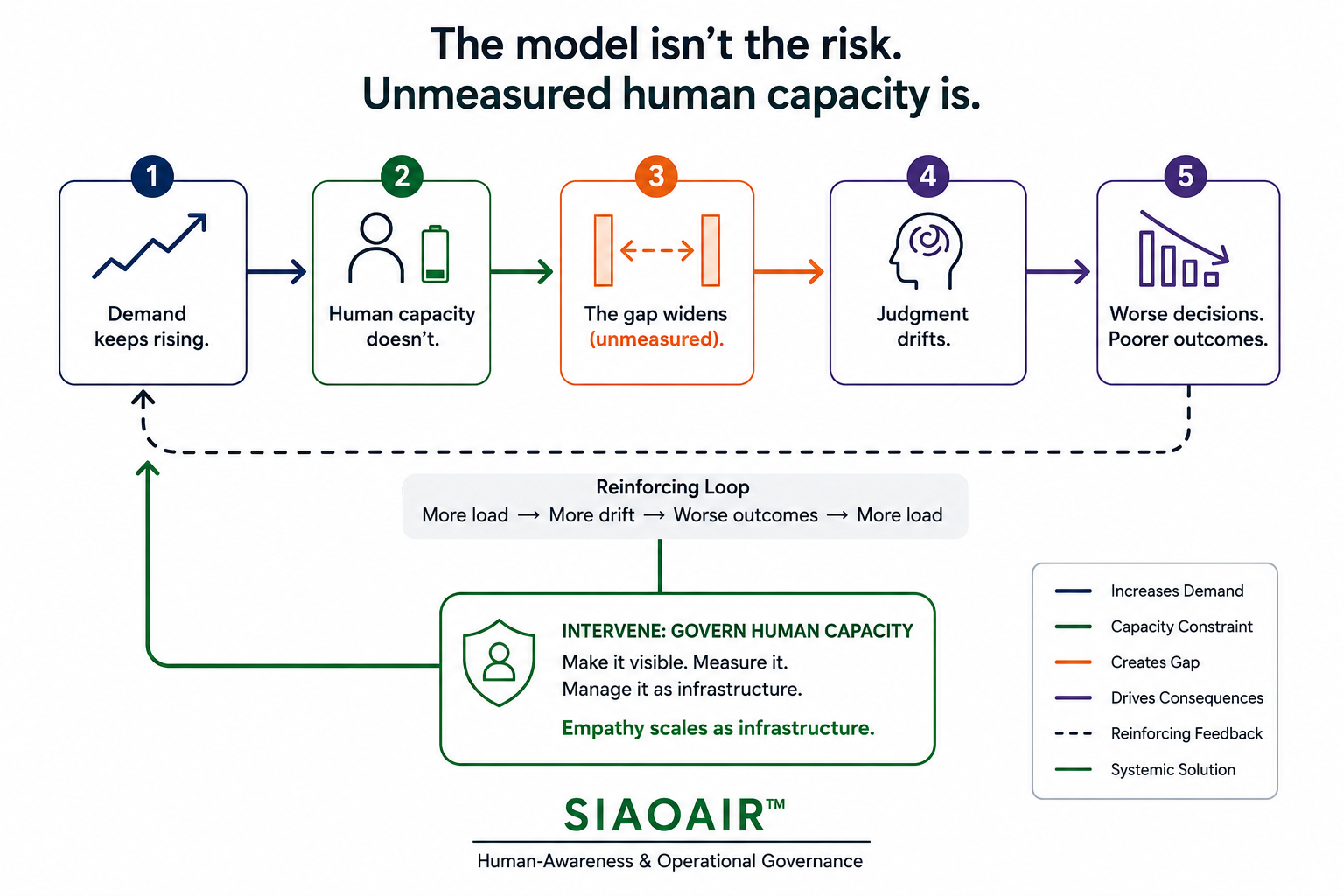
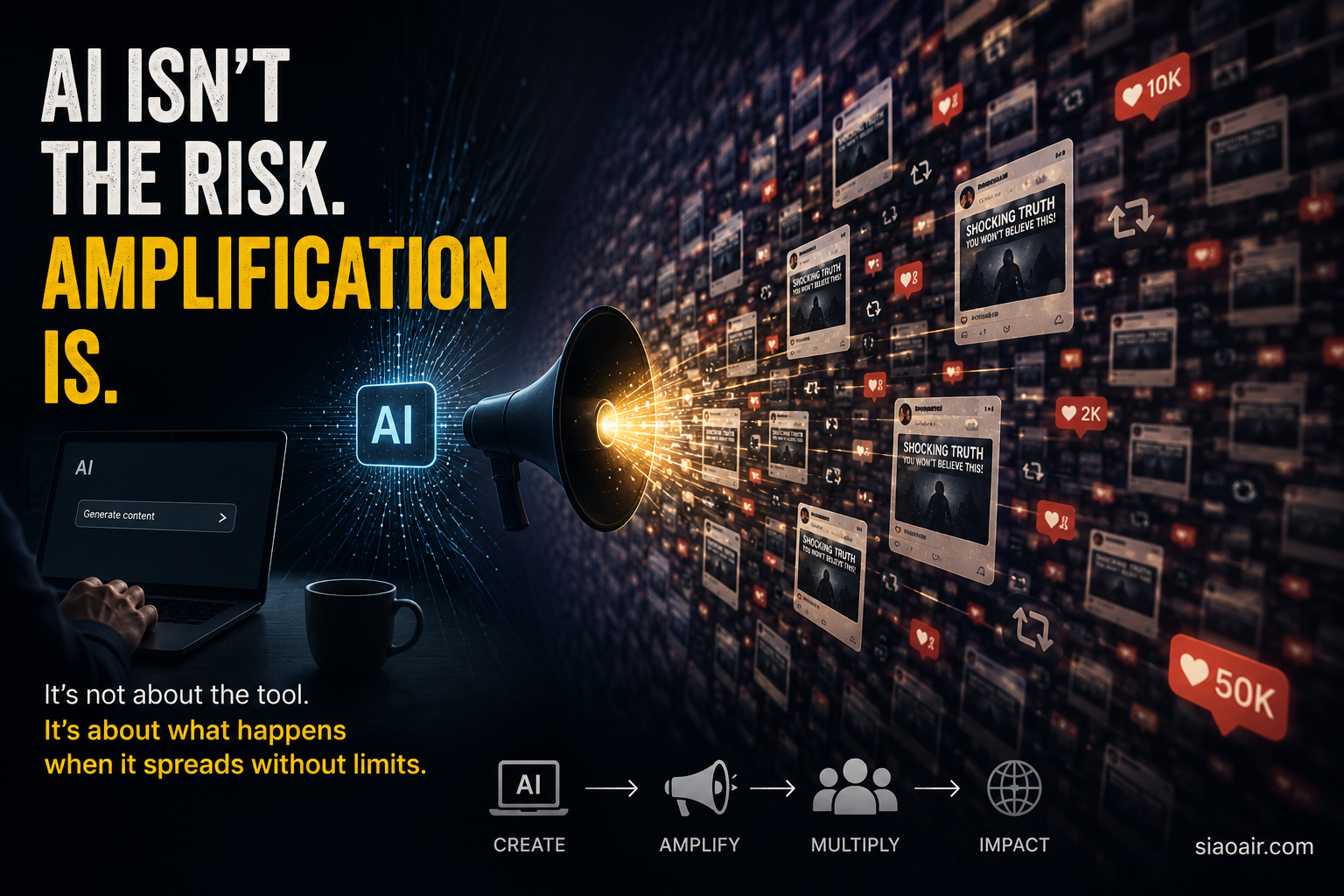
With all the momentum around AI, the focus has shifted to speed — faster models, faster outputs, faster decisions. But AI is not introducing new risk. It is amplifying what already exists. And without constraint, amplification turns small weaknesses into systemic failures. The Nature of Amplified Risk Every system already carries friction — inequality, unclear … Read moreAI Isn’t the Risk. Amplification Is

Categories Uncategorized

The SIAOAIR™ Manifesto

Intelligent systems learned to model machines.The next generation of intelligent systems must model humans. Artificial intelligence is accelerating the speed of modern systems. Execution velocity is increasing.Signal density is rising.Workflows that once unfolded gradually now occur instantly across machines, models, and autonomous agents. Infrastructure has evolved to support this scale. Systems monitor CPU utilization, memory … Read moreThe SIAOAIR™ Manifesto

The Missing Runtime Constraint in Enterprise AI

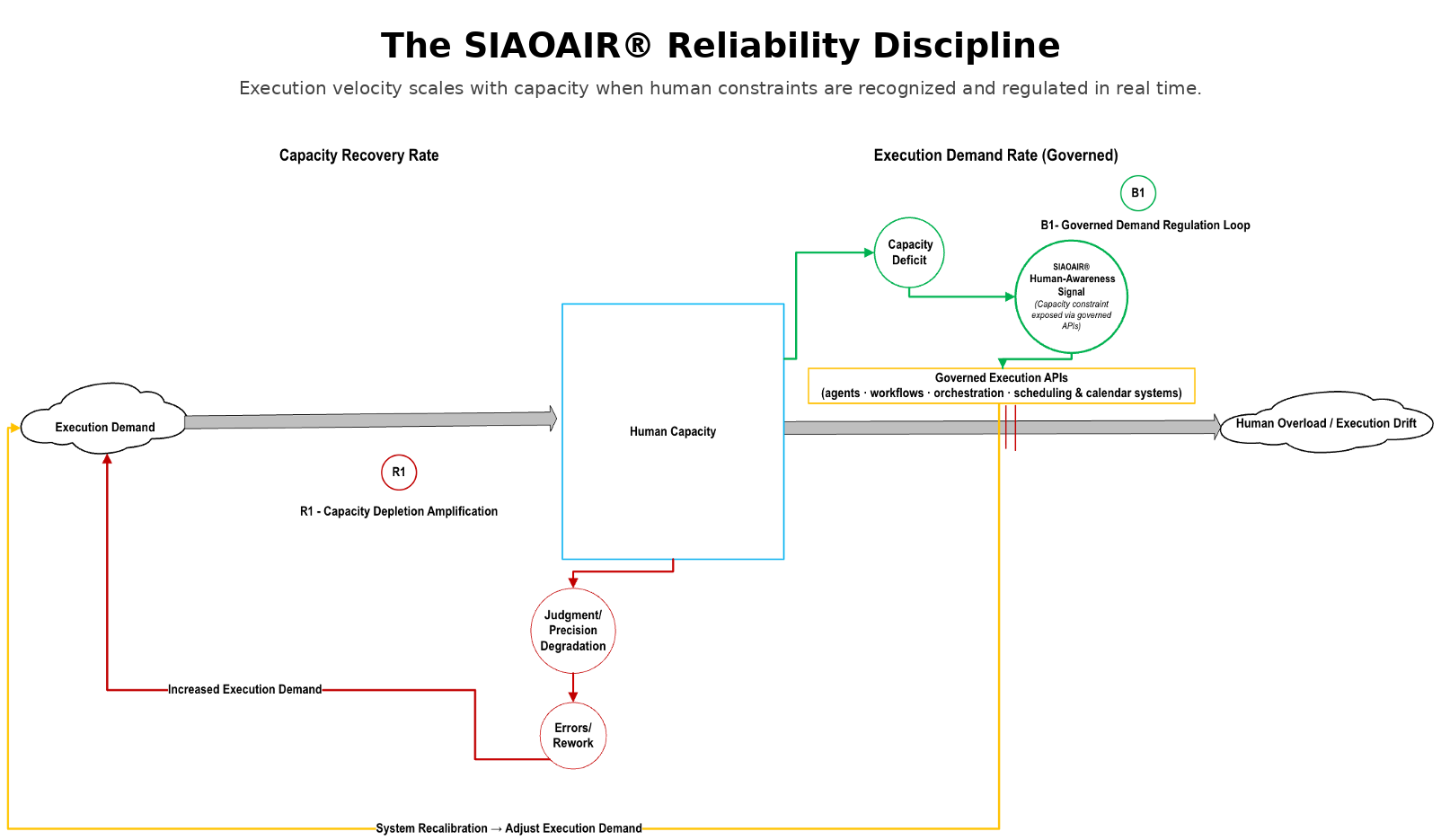
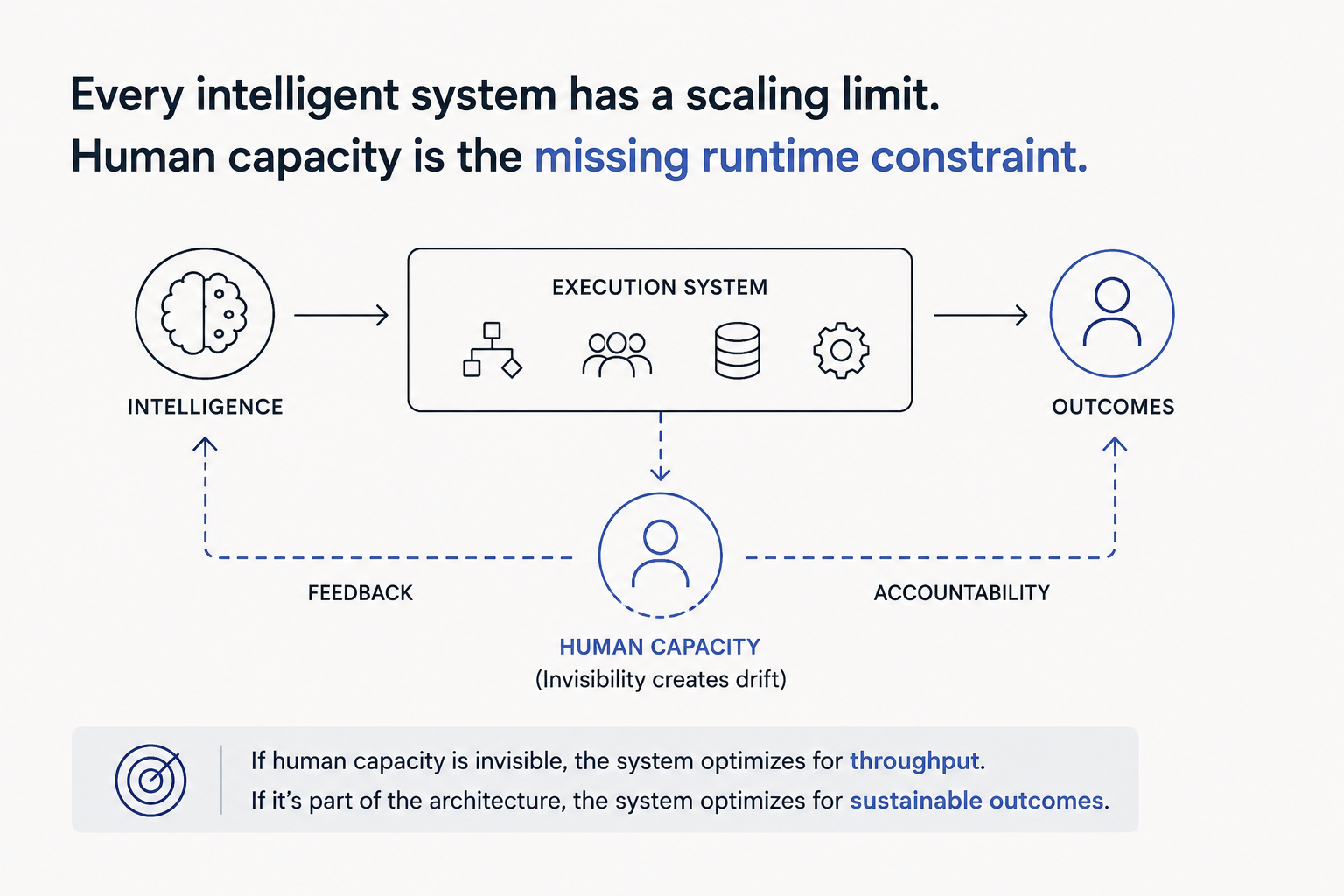
Enterprise systems are designed to model limits. Latency budgets. Throughput ceilings. Memory constraints. Error budgets.They monitor congestion, enforce rate limits, and apply backpressure—so execution holds under load. Modern infrastructure no longer attributes instability to individuals.It models constraints explicitly, and governs them in real time. But one constraint remains largely unmodeled: Human capacity. As AI scales, … Read moreThe Missing Runtime Constraint in Enterprise AI

The Human System

Every system eventually reveals its weakest constraint. In modern systems, that constraint is rarely compute, data, or automation.It is the human system. The human system is where systems either holdor quietly fail. Human Capacity Is Not Constant Not because people aren’t capable—but because capacity is human. Finite.Contextual.Lived. Judgment varies with human load.Clarity varies with readiness.Performance … Read moreThe Human System

Systems Talk to Systems.

SIAOAIR™ Enables the Human System to Talk Back Modern systems communicate constantly. APIs exchange signals.Telemetry streams flow.Automation responds in milliseconds. Yet the earliest indicators of failureare not found in logs. They are found in people. Strain.Cognitive overload.Fatigue that precedes errors, disengagement, burnout, and outages. Long before systems fail,humans register the drift. The Invisible Failure Mode … Read moreSystems Talk to Systems.

When Technology Learns to Be Calm

Digital health has no shortage of innovation.What it lacks is calm. Long before alerts, dashboards, and AI copilots, two thinkers asked a better question:What should technology feel like when it truly serves humans? Their answer still defines the future. The Insight We Forgot In the early 1990s, Mark Weiser imagined technology that didn’t demand attention.The … Read moreWhen Technology Learns to Be Calm

The Real ROI of AI: Workflows That Sense, Adapt, and Protect Before They Break

Most organizations still treat workflow optimization as a tooling problem: add more dashboards, automate more steps, tighten more SLAs.But none of that creates real improvement if the workflow itself lacks awareness. You cannot optimize what you cannot sense. Workflows break long before metrics do.They break in the weak signals most systems never capture: rising human … Read moreThe Real ROI of AI: Workflows That Sense, Adapt, and Protect Before They Break

From Architecture to Awareness: When Systems Begin to Listen

Some work asks more than the system is built to hold. A nurse stretches across one more patient.A teacher carries a full classroom on an empty tank.An analyst moves through alerts while their focus thins.A field engineer pushes through heat, noise, and risk because the work won’t wait. On the surface, everything looks “managed.”Underneath, capacity … Read moreFrom Architecture to Awareness: When Systems Begin to Listen