
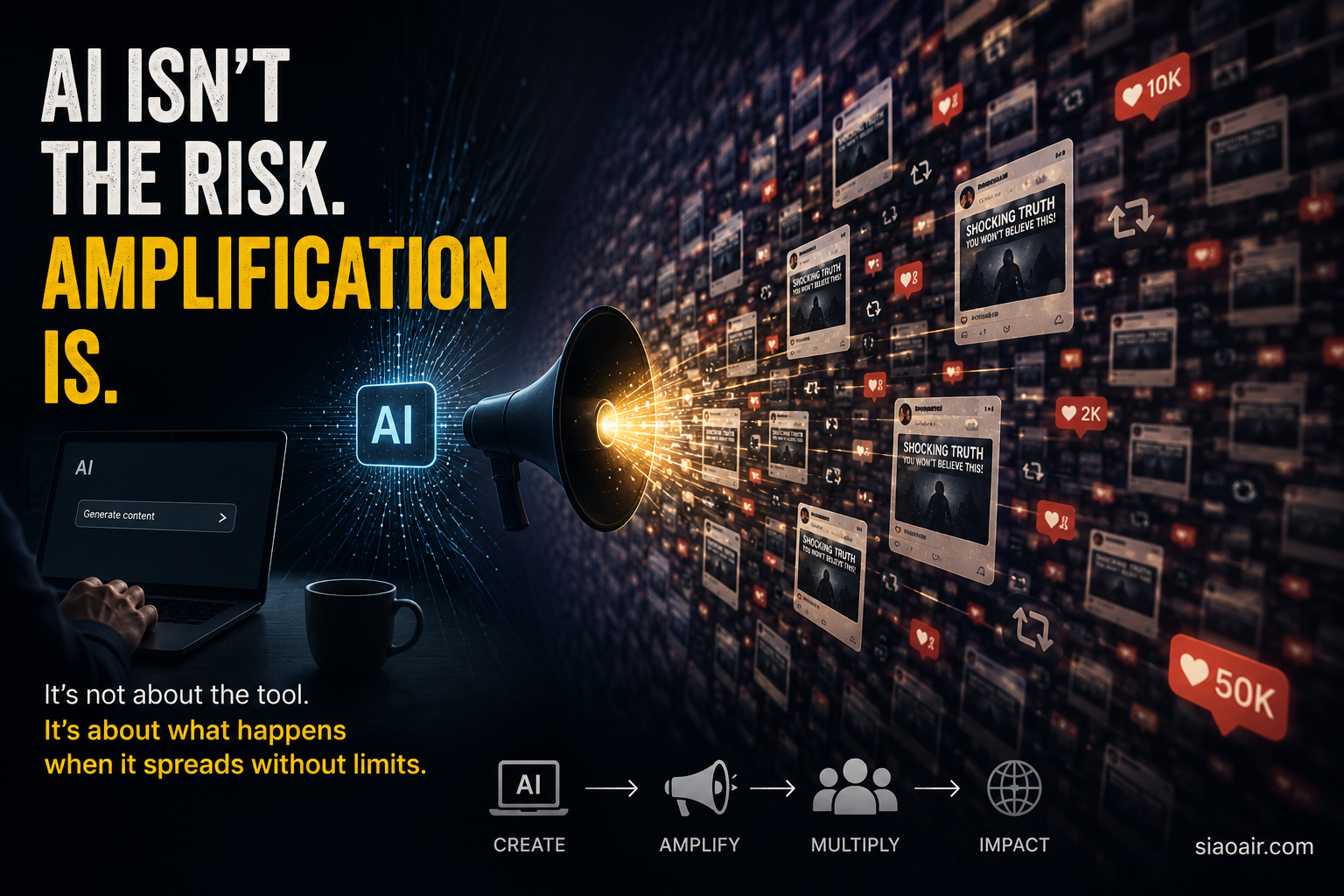
Strategic Planning Assumption: Through 2028, organizations that treat AI risk as a property of the model rather than a property of the system it runs inside will find that AI amplifies existing structural weaknesses faster than governance can respond.
Overview
Every conversation about AI right now is a conversation about speed: faster models, faster outputs, faster decisions. But speed is the wrong thing to be watching.
AI is not introducing new risk. It’s amplifying what was already there. And without constraint, amplification turns small weaknesses into systemic failures.
Analysis
1. The nature of amplified risk
Every system already carries friction — inequality, unclear decisions, fragmented accountability, human limits that were never modeled in the first place. Before AI, that friction moved at a pace people could manage. Contained. Correctable.
Now it moves instantly. What used to stay local becomes systemic before anyone notices.
The problem was never intelligence. It’s ungoverned scale.
2. The illusion of progress
Speed, automation, and output volume get read as progress. They’re not. They’re acceleration — and acceleration without stability is drift waiting to happen.
As systems move faster, decisions compound, signals multiply, and human oversight gets outpaced. The drift is subtle at first. Then it isn’t. Systems rarely fail all at once — they lose alignment first, and the failure just makes that loss visible.
3. Resilience as infrastructure
Amplification changes what resilience has to mean.
Today, resilience is still treated as something people do — absorb, adapt, keep pace. That model was already fragile. Under rising signal density and faster execution, it breaks.
Resilience can’t live with the individual. It has to be built into the system itself:
- At the device — where execution happens in real time — signals are constrained before they exceed human capacity.
- Across the system — those constraints propagate outward, regulating demand, shaping coordination, and preserving coherence under load.
The result: as amplification increases, execution stays bounded, decisions stay coherent, and the system holds.
4. Social good is a design choice
“AI for social good” isn’t a separate initiative you bolt on. It’s a structural decision made upstream, in how execution is governed.
AI scales whatever the system allows. If the foundation is misaligned, AI won’t correct that — it will amplify it. The outcome isn’t determined by intent. It’s determined by governance.
5. Governing at the point of execution
SIAOAIR® introduces the layer most systems are missing: operational governance at runtime.
It keeps execution demand within human capacity, regulates signals before they overload the system, and stabilizes decisions under pressure — not after failure, but at the moment failure would otherwise occur.
6. The inevitability
AI will keep scaling. Signal density will keep rising. Decision velocity will keep increasing. None of that is optional — it’s already underway.
Without governance at the point of execution, systems will drift. Inequality will widen. Instability will compound. Not because these systems lack intelligence — because they lack constraint.
Recommendations
The advantage won’t come from deploying AI faster than everyone else. It will come from ensuring your systems hold as they scale.
In an era of amplification, social good isn’t what AI does. It’s what the system allows to persist.
Bottom Line
Without operational governance at runtime, amplification will scale what breaks faster than anyone can correct it.