
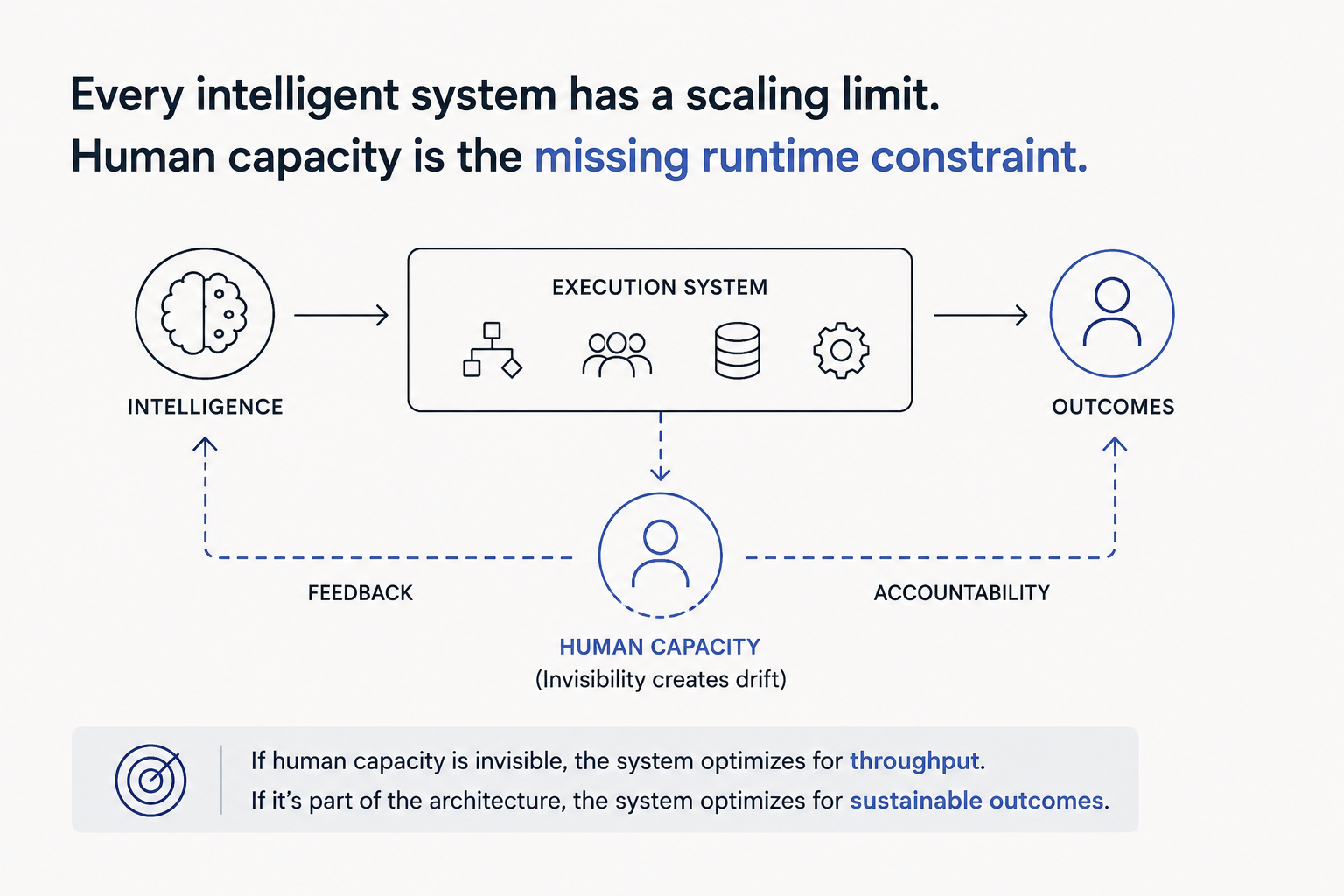
Strategic Planning Assumption: Through 2028, enterprises that automate machine-to-machine coordination without governing the human-execution boundary will see decision quality erode under load, even as system-level dashboards report normal operation.
Overview
Across enterprise AI deployments, a consistent pattern is emerging: decision authority is being distributed to machines faster than the humans still accountable for those decisions can absorb the load.
Organizations have optimized for system-to-system communication — automation at scale, real-time orchestration, agent coordination. That work is real, and it’s paying off at the infrastructure layer.
One system remains largely invisible: the human system. Not ignored — unmodeled. The system responsible for judgment, escalation, and accountability at the exact points where machine output still requires a person to decide.
Analysis
1. Where the strain is surfacing
That’s where the strain is surfacing. Decision fatigue in high-signal environments. Coordination breakdowns despite better tooling. Escalation loops replacing resolution. Rising cognitive load as signal density increases faster than review capacity does.
2. Signs of drift, not inefficiency
These aren’t isolated inefficiencies. They’re signs of drift — not because the AI isn’t working, but because execution is outpacing the governance built to keep it reliable.
3. The automation asymmetry
Here’s the asymmetry: engineering teams already do this for machines. When a queue backs up, they add backpressure. When a service gets overwhelmed, they rate-limit. When error budgets burn too fast, they trigger a circuit breaker and slow the system down before it fails. None of that logic has been extended to the human side of the same pipeline. Escalations and approvals still route to a person as if their attention were an unbounded resource — no queue depth, no threshold, no signal that says slow down, this person is at capacity. The instrumentation exists everywhere except the one place decisions actually get made.
4. Why it stays invisible
Human capacity was never designed into the system as a constraint. So it doesn’t fail all at once. It drifts — and drift is harder to catch than an outage, because a person under load doesn’t stop working, they start rubber-stamping. From the outside, careful review and exhausted approval look identical. That’s what makes this failure mode invisible on a dashboard.
Recommendations
The next phase of enterprise AI won’t be defined by more intelligence. It will be defined by governance at the one boundary that hasn’t been automated: where machine execution meets human judgment.
Reliable systems won’t be determined by how well machines talk to each other. They’ll be determined by whether human capacity is made visible, measurable, and governed in real time — as part of execution, not a report on it afterward.
Not after burnout. Not after failure.
Human capacity is the missing runtime constraint in enterprise AI. Until it’s modeled and governed, execution won’t hold at scale.
Bottom Line
SIAOAIR: Resilience as infrastructure.