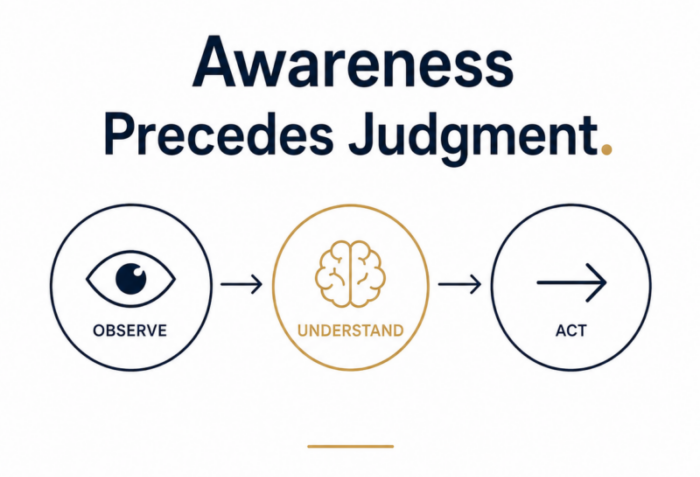
Judgment Is an Architectural Constraint

Strategic Planning Assumption: Through 2028, organizations that allow judgment to precede observation will see adaptive capacity erode even as response metrics stay within tolerance — because reactivity is being measured while observability is not. Overview Organizations often interpret reactivity as a performance issue. More often, it is an observability issue. When judgment precedes observation, awareness … Read moreJudgment Is an Architectural Constraint

The Human Constraint in Intelligent Systems

Strategic Planning Assumption: Through 2028, intelligent systems that model machine constraints without modeling human capacity will encounter the same reliability failures infrastructure teams already solved for compute — but at the human layer, and later than necessary. Overview Every system that scales eventually encounters the limit it failed to account for. This isn’t a matter … Read moreThe Human Constraint in Intelligent Systems

The Missing Runtime Constraint in Enterprise AI

Strategic Planning Assumption: By governing execution demand without modeling human capacity as a runtime constraint, enterprise AI systems will continue to drift toward instability at the human-execution boundary — masked by dashboards that remain within tolerance. Overview Enterprise systems are designed to model limits. Latency budgets. Throughput ceilings. Memory constraints. Error budgets.They monitor congestion, enforce … Read moreThe Missing Runtime Constraint in Enterprise AI

The Human System

Strategic Planning Assumption: Through 2028, systems that model machine constraints while leaving human capacity unobserved will experience reliability decay that surfaces as culture or attrition problems rather than as the architectural gap it actually is. Overview Every system eventually reveals its weakest constraint. In modern systems, that constraint is rarely compute, data, or automation.It is … Read moreThe Human System

Systems Talk to Systems.

Strategic Planning Assumption: Through 2028, organizations that instrument system telemetry without instrumenting human strain will continue to discover failure only after it surfaces as burnout, disengagement, or outage — rather than at the point where it was still correctable. Overview Modern systems communicate constantly. APIs exchange signals. Telemetry streams flow. Automation responds in milliseconds. Yet … Read moreSystems Talk to Systems.

When Technology Learns to Be Calm

Digital health has no shortage of innovation.What it lacks is calm. Long before alerts, dashboards, and AI copilots, two thinkers asked a better question:What should technology feel like when it truly serves humans? Their answer still defines the future. The Insight We Forgot In the early 1990s, Mark Weiser imagined technology that didn’t demand attention.The … Read moreWhen Technology Learns to Be Calm

The Real ROI of AI: Workflows That Sense, Adapt, and Protect Before They Break

Strategic Planning Assumption: Through 2028, organizations that optimize workflows without sensing human strain will continue to see symptoms — burnout, rework, cycle-time creep, churn — only after the workflow has already exceeded its load. Overview Most organizations still treat workflow optimization as a tooling problem: add more dashboards, automate more steps, tighten more SLAs.But none … Read moreThe Real ROI of AI: Workflows That Sense, Adapt, and Protect Before They Break

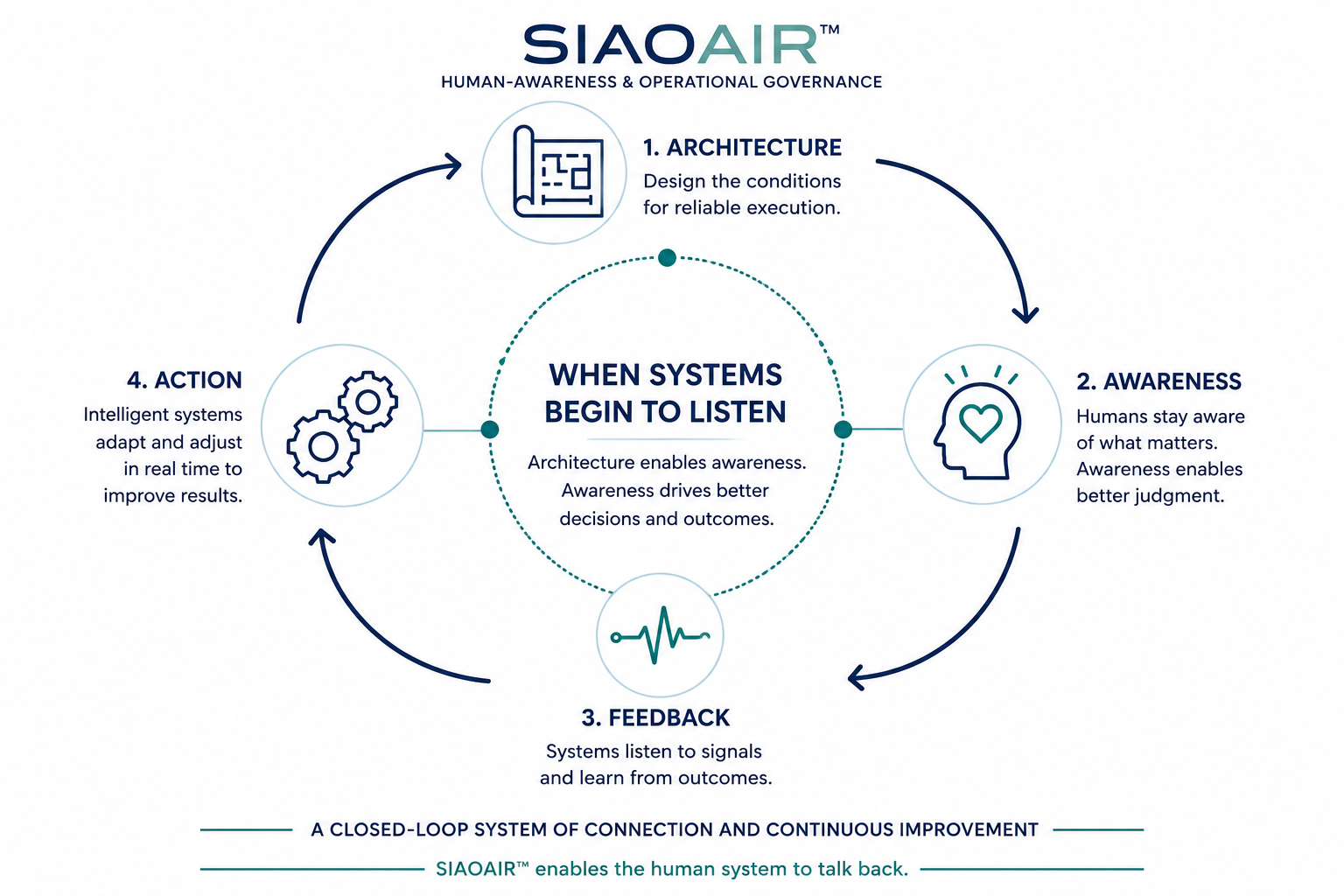
From Architecture to Awareness: When Systems Begin to Listen

Some work asks more than the system is built to hold. A nurse stretches across one more patient. A teacher carries a full classroom on empty. An analyst moves through alerts while their focus thins. A field engineer pushes through heat, noise, and risk because the work won’t wait. On the surface, everything looks managed. … Read moreFrom Architecture to Awareness: When Systems Begin to Listen

From Empowerment to Architecture: The Mission That Shaped SIAOAIR™

When Microsoft first declared its mission — a computer on every desk and in every home — it wasn’t just about technology. It was about human potential. Later, that evolved into empowering every person and every organization on the planet to achieve more. For me, those words were never a slogan. They were a blueprint … Read moreFrom Empowerment to Architecture: The Mission That Shaped SIAOAIR™

Change at the Edge: Why SIAOAIR Was Built

Change is rarely simple. It forces a decision: what to become. Technology has scaled with astonishing speed, but one thing has consistently gone unmeasured—the human cost. Burnout behind dashboards. Silence where brilliance should have spoken. Fatigue on the faces driving billion-dollar transformations. The truth is clear: the smartest tools in the world cannot protect the … Read moreChange at the Edge: Why SIAOAIR Was Built