
Some work asks more than the system is built to hold.
A nurse stretches across one more patient. A teacher carries a full classroom on empty. An analyst moves through alerts while their focus thins. A field engineer pushes through heat, noise, and risk because the work won’t wait.
On the surface, everything looks managed. Underneath, capacity is quietly eroding.
We give it many names — burnout, churn, near-misses, outages, disengagement. Underneath, it’s one loop, failing the same way.
Not because people are weak. Because the loop never closes around them.
Human Strain, Simply
Human strain is the early signal that capacity is being spent faster than it recovers.
It shows up as slower thinking, small mistakes, tight shoulders, scattered focus, being “always on.” A sign, not a diagnosis.
Most tools never catch it. They only see what’s left after the loop breaks.
The Design Flaw
Modern systems track output, speed, errors — and close the loop around them, in real time. Human strain gets none of that.
Signals rise. Nothing adjusts. The loop stays open. People absorb the load until something gives.
It looks personal. It isn’t. It’s architectural: a loop that never closes around the human.
What SIAOAIR® Is
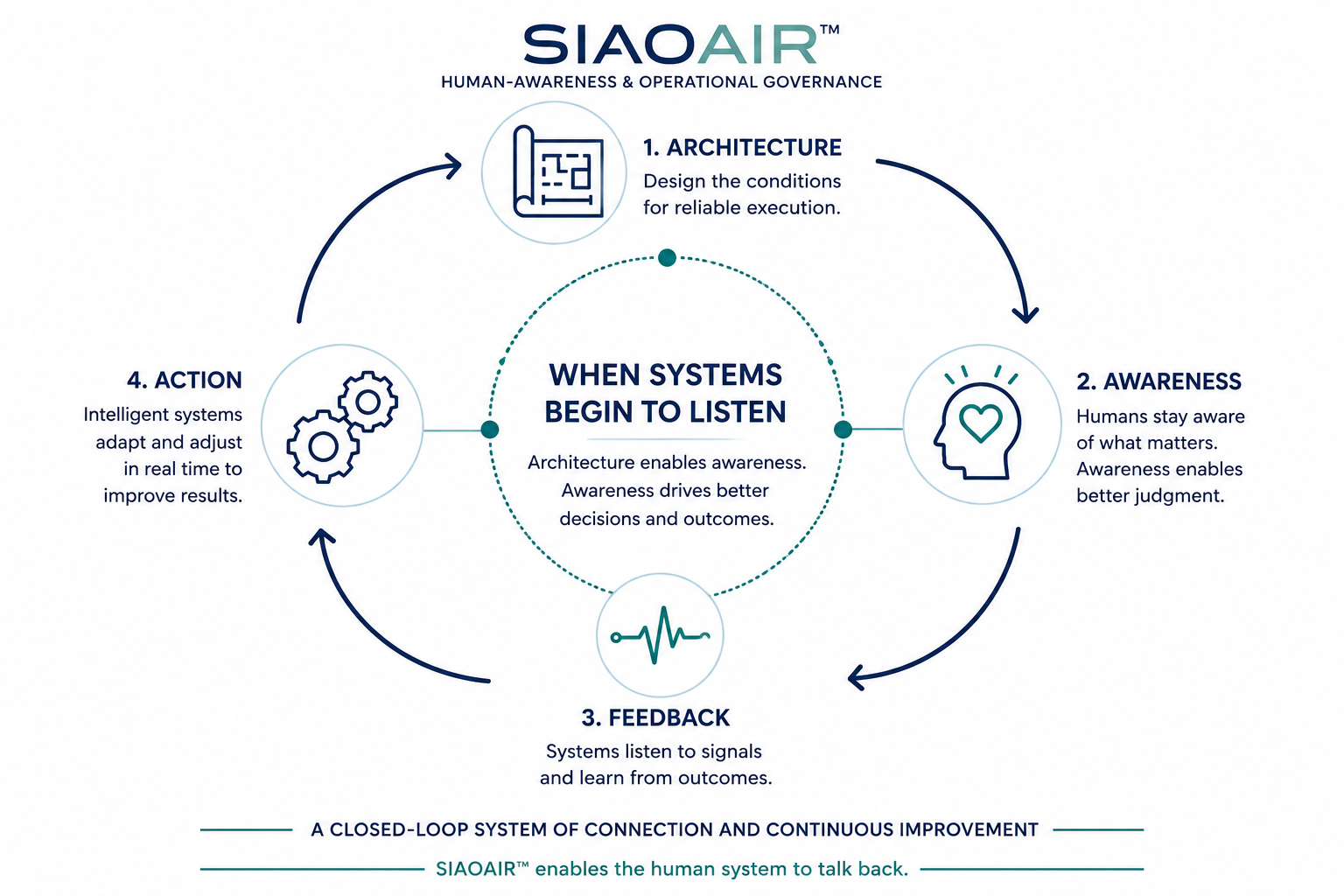
SIAOAIR® is a real-time, on-device resilience platform.
It gives systems the one thing they’ve been missing: the ability to sense strain, and close the loop around it.
It reads human strain and system drift across wearables, phones, laptops, and tablets — locally, privately, in real time.
Then it closes the loop:
Sense → Interpret → Act → Observe → Adapt → Improve → Report
Small, timely adjustments for the person — a breathing cue, a hydration nudge, a moment of presence. Managers stay in the loop too, so workloads rebalance and recovery gets protected before something breaks.
Protect the human first. That’s how the system stays whole.
Resilience as Infrastructure
Burnout, near-misses, outages, churn, disengagement — not isolated events. The predictable output of loops that optimize for throughput and never close around human limits.
SIAOAIR is the missing layer. A platform that senses. A loop that closes. An architecture built around human capacity, not around it.
If this pattern is familiar, the loop is already open in your organization.
This is resilience as infrastructure.