
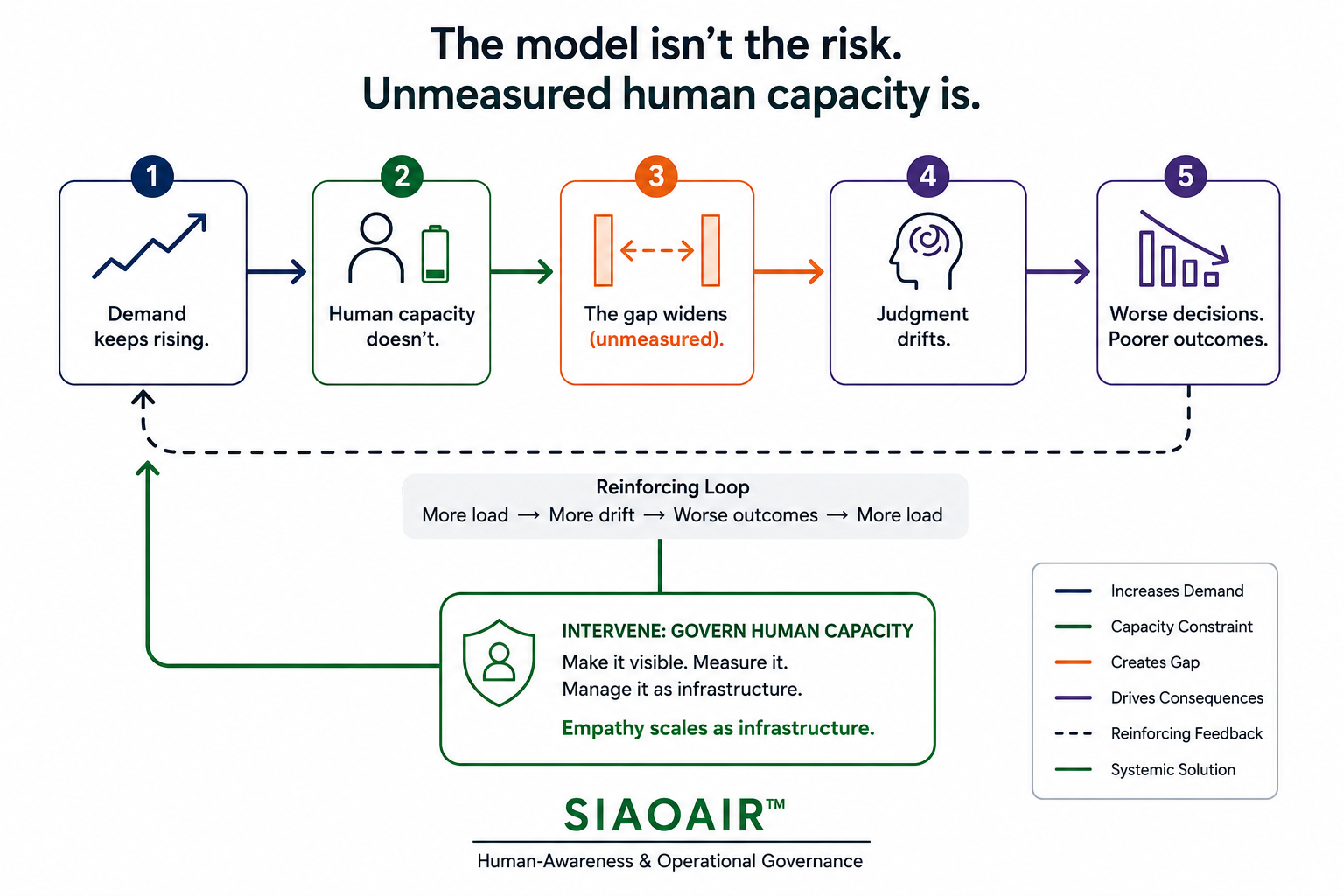
Strategic Planning Assumption: Through 2028, AI systems that treat empathy as a preserved human trait rather than a governed runtime mechanism will continue to let execution demand scale independently of human capacity — producing drift long before visible failure.
Overview
The limitation of empathy as a trait
As AI scales, empathy is often framed as a human advantage — something to preserve alongside automation. That framing does not hold at system level. Empathy does not scale as a trait. It scales as infrastructure.
Analysis
1. The structural problem
AI is increasing decision velocity, signal density, and continuous execution across systems, while human capacity — the cognitive, emotional, and attentional bandwidth required for sound judgment — remains finite. Most systems do not model this constraint. They optimize for throughput and coordination while leaving the human layer unobserved.
2. Where instability begins
When human capacity is invisible, execution demand scales independently of it. Reinforcing loops amplify activity, decisions accumulate, and load increases — often without visible failure at first. Instability emerges gradually as drift, long before systems break.
3. Reframing empathy
At scale, empathy is not awareness. It is the mechanism by which systems remain aligned with human capacity. In architectural terms, it becomes the way resilience is enforced — not after stress, but within execution itself.
Recommendations
SIAOAIR: operationalizing empathy
SIAOAIR® introduces human-aware runtime operational governance, making human capacity observable, interpretable, and governable inside AI-driven systems. Deployed across edge devices, it surfaces real-time human capacity signals and enables systems to regulate execution demand accordingly. It does not execute work or replace orchestration — it constrains execution so demand remains proportional to human limits.
The shift to infrastructure
This is the shift from resilience as reaction to resilience as infrastructure. When resilience is embedded, systems no longer depend on humans to absorb instability. Execution adjusts in real time, balancing loops strengthen, and stability is preserved under growth.
Bottom Line
Resilience reacts. Runtime empathy regulates. That is resilience as infrastructure.