
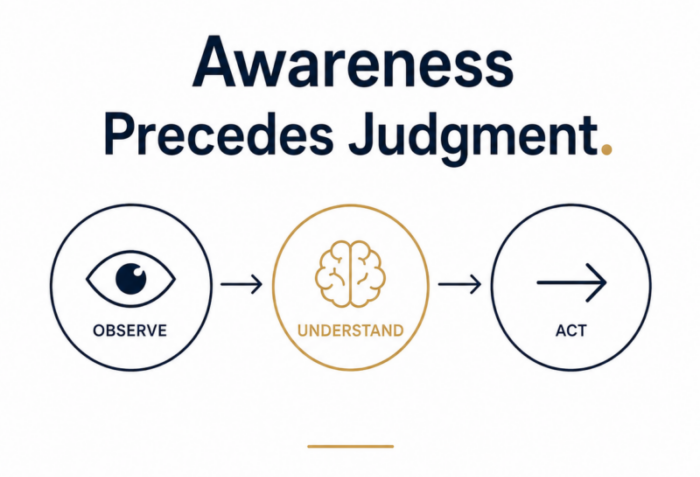
Strategic Planning Assumption: Through 2028, organizations that allow judgment to precede observation will see adaptive capacity erode even as response metrics stay within tolerance — because reactivity is being measured while observability is not.
Overview
Organizations often interpret reactivity as a performance issue. More often, it is an observability issue. When judgment precedes observation, awareness narrows, feedback weakens, and assumptions replace understanding. The consequence is predictable: organizations become increasingly responsive to events while progressively losing the capacity to adapt to the conditions that produce them.
Analysis
1. The constraint
Judgment is not simply a cognitive process. It is a constraint on awareness. The moment a system concludes what a situation means, it reduces its capacity to observe what is actually emerging. Observation gives way to assumption, assumptions shape decisions, and decisions reinforce existing system conditions.
The consequence is not isolated misjudgment. It is diminishing observability across the system.
2. The pattern
As observability declines, organizations shift their attention toward visible events rather than underlying conditions. Symptoms receive immediate attention while the structures producing those symptoms remain unchanged. Decision velocity increases while learning capacity declines. The organization appears increasingly responsive while becoming progressively less adaptive.
This is the inevitable progression of the Shifting the Burden systems archetype: as attention migrates toward managing consequences, the capacity to observe underlying causes continues to erode.
3. The amplifier
Human capacity determines how much awareness an organization can sustain. As cognitive load, fatigue, stress, and competing demands increase, the ability to remain observant contracts. Judgment accelerates, reactivity follows, and adaptive capacity deteriorates.
What appears to be a communication problem is often an operational consequence of constrained human capacity.
4. The architectural implication
Organizations rarely fail because they lack judgment. They fail because judgment occurs before sufficient observation has taken place.
Most governance systems reinforce this pattern. They measure outcomes, evaluate decisions, and optimize responses after execution has already occurred. Few govern the conditions that preserve awareness before judgment is formed.
The consequence is inevitable. Feedback loops weaken, learning slows, and reactive behavior becomes structurally embedded within the system.
Recommendations
SIAOAIR® is founded on a different architectural principle.
Reliable systems preserve awareness before judgment. They strengthen observability before accelerating action because the quality of every decision is constrained by the quality of the awareness that precedes it.
Bottom Line
Awareness is not the opposite of judgment. It is the condition that makes sound judgment possible.